


In the previous post, we opened Anthropic’s performance-review Skill and looked at its anatomy: metadata, modes, instructions, output structures and connectors.
Today, I want to ask a slightly less polite question:
Is it actually a good Skill?
And a slightly less polite answer: it is a very good starting point, but I would not use it in a real performance cycle without changing several things first.
To be fair, Anthropic explicitly describes these plugins as generic starting points and says they become more useful once you customize them for your company’s terminology, processes and workflows.
So let’s do exactly that.
First, HR, we need to talk
Before we touch anything, compare the performance-review Skill with some of the other Skills in the same Anthropic repository.
You do not even have to look at the engineering ones. Open the Legal Risk Assessment Skill.
The HR performance-review Skill is 109 lines of actual content. The Legal Risk Assessment Skill is 204. But this is not a competition for who can write the longest SKILL.md. More context is not automatically better context.
What hurts a little is what those extra lines are doing.
Legal explains how to reason about the task, what the boundaries are and when the AI should escalate rather than continue confidently on its own.
HR gets three templates, some connector instructions and four tips at the bottom.
And performance reviews are not exactly a low-stakes activity either.
So yes, I am taking this personally.
Wait. Where exactly are we going to edit this?
Anywhere you are comfortable writing text.
Seriously.
If looking at GitHub already makes you want to close this article, copy the content of SKILL.md into:
Google Docs;
Microsoft Word;
TextEdit;
Notepad;
your favorite Markdown editor (do people have favorite Markdown editors?);
or even a fresh chat with your LLM.
We are working on the logic, not trying to win a Markdown formatting competition.
Once you are happy with the content, give it to your LLM and say:
Turn this into a valid SKILL.md. Preserve my rules and business logic, structure it clearly for an AI agent, and do not invent any additional policies or requirements.
And in the next posts, I’ll show you how to create your own Skills instead of editing somebody else’s. The good news is no magical developer substance inside SKILL.md.
Now we can get back to HR.
Step 1. The description: good
The Skill starts with:
name: performance-review
and a fairly detailed description explaining when it should be used: self-assessments, manager reviews, calibration, promotion cases and turning vague feedback into behavioral examples.
This is good.
As we discussed in the previous post, the description is not just a label for humans. It helps the system understand when this capability is relevant.
It also has:
argument-hint: <employee name or review cycle>
Also useful, but I would improve it.
The Skill actually supports three modes:
self-assessmentmanagercalibration
So I would make the interface reflect that.
Something like:
<self-assessment | manager | calibration> [employee or review cycle]
Small change. Clearer expectation. But not mandatory.
Verdict: good as it is. The argument hint could be a little more informative, but this is UX polish rather than a meaningful change to the Skill itself.
Step 2. The three modes: excellent
This is probably the strongest design decision in the whole Skill.
Instead of one huge instruction saying help with performance management, it separates the workflow into three jobs:

Each one then gets its own output, this is exactly what I want from a Skill. I would change only one line.
Currently:
If no mode is specified, ask what type of review they need.
That is safe, but slightly robotic.
If I write:
Help me prepare Anna’s annual performance review.
the model can probably infer that I need the manager-review workflow.
I would make the rule:
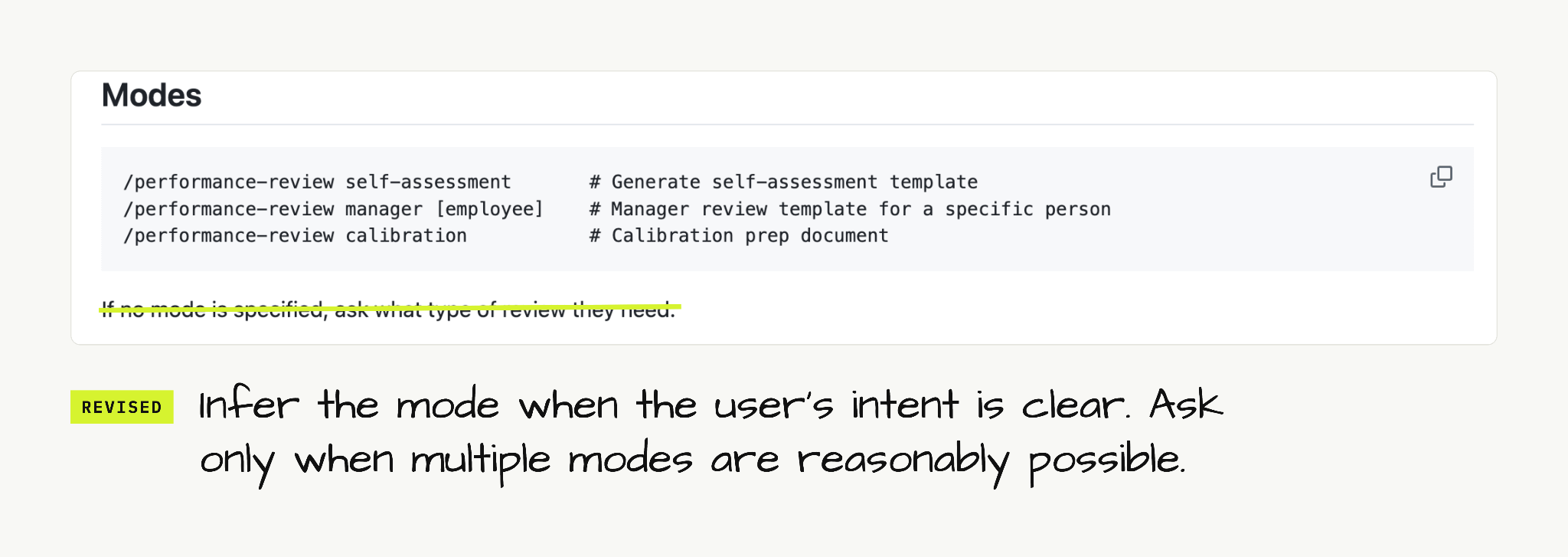
A good Skill should remove unnecessary work, not create a new form for HR to fill in.
Verdict: excellent. Keep the structure. Make the clarification rule smarter.
Step 3. The output templates: very good
The self-assessment does not merely say describe your achievements.
It asks for:
situation;
contribution;
impact.
Goals require evidence. Development areas require actions. Manager feedback requires specific examples. Calibration gets a structured team overview and discussion points.
This is exactly the kind of structure that makes a Skill useful.
We are reducing the number of decisions the model has to improvise every time.
But there is a trap here.
A template can quietly become company policy.
And this Skill crosses that line in several places.
Step 4. The rating system: this needs fixing
The manager-review template assumes:
Exceeds / Meets / Below Expectations
Then calibration goes further and includes this target distribution:
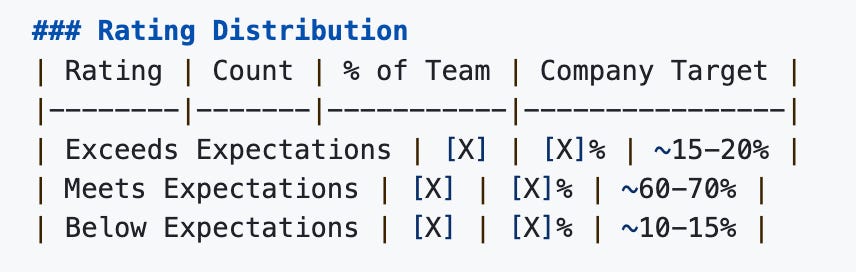
Where did that come from?
Your organization might use five ratings. Or four. Or two dimensions: results and behaviors. Or no ratings at all.
The generic Skill cannot know any of this.
This is the first thing I would replace with a rule:
Use the organization’s performance framework, rating scale and calibration rules when they are available. Never invent a rating scale, target distribution or forced distribution. If the required framework is missing, ask for it or explicitly mark it as unavailable.
That is a much safer default.
And it gives us one useful rule for writing Skills in general:
Templates can be generic. Business rules cannot.
Step 5. Evidence retrieval: excellent idea, not enough rules
Near the end, the Skill gets much more interesting.
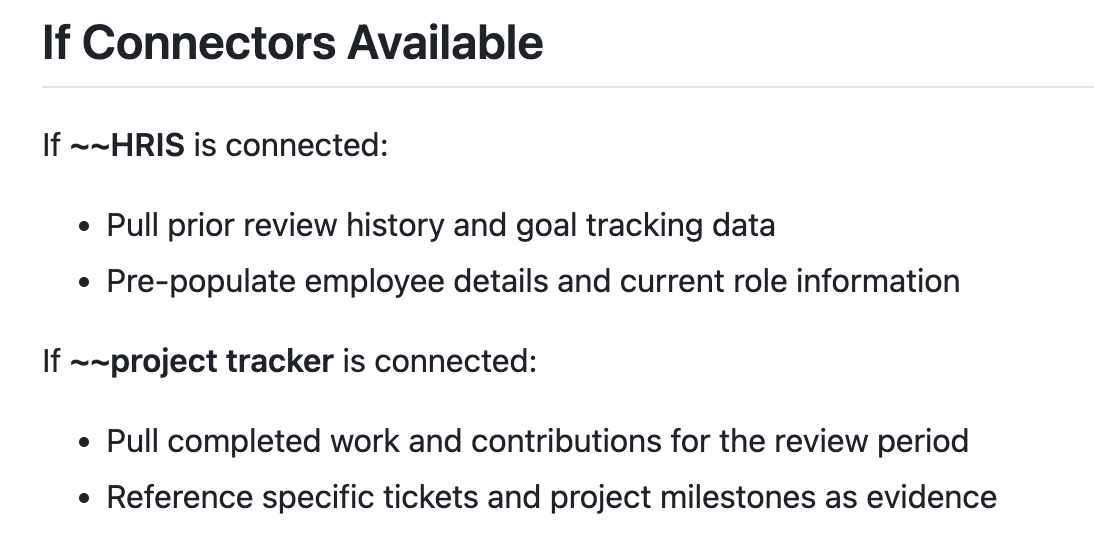
This is excellent.
One of the worst parts of a traditional annual review is expecting a manager to reconstruct twelve months of somebody’s work from memory.
AI can help with exactly that.
But find more information is not enough of an instruction.
I would add rules for what counts as evidence:
Use evidence from the defined review period.
Separate documented outcomes from opinions and self-reported claims.
Do not treat absence of recorded evidence as evidence of poor performance.
If sources contradict each other, surface the contradiction instead of silently choosing one version.
Never invent a specific example merely to make feedback sound more convincing.
If there is insufficient evidence to support a conclusion, say so.
Now we are not just giving AI more context.
We are telling it how it is allowed to use that context.
That distinction matters enormously.
Verdict: excellent direction, but the evidence-handling rules need to be much stronger.
Step 6. Promotion and compensation: slow down
The manager-review template ends with a Compensation Recommendation.
The calibration template includes Promotion Candidates and Compensation Actions, including promotion, equity refresh, market adjustment and retention.
That is a lot of authority for a Skill that has not been given a promotion framework or compensation policy.
High performance does not automatically equal promotion.
Promotion readiness should normally be assessed against expectations at the next level, not simply against how well somebody performs in the current one.
And these are different questions:
Does this person deserve a higher performance rating?
Are they ready for promotion?
Are they positioned correctly within their salary band?
Do we have a market-pay problem?
Do we have a retention problem?
Please do not let AI quietly turn those into one column called “Compensation Recommendation.”
I would change this section to something like:
Only assess promotion or compensation actions when the relevant organizational criteria, level expectations and compensation policies are available. Do not infer promotion readiness from performance rating alone. Where the required information is unavailable, flag the decision for human review rather than generating a recommendation.
Verdict: useful functionality, but only with much stronger company context and decision boundaries.
Step 7. The biggest missing section: when AI should stop
This becomes especially obvious when you compare the HR Skill with Legal.
The Legal Risk Assessment Skill explicitly says that it supports legal workflows but does not provide legal advice, that assessments should be reviewed by qualified professionals, and then defines multiple escalation conditions.
Our performance Skill has no equivalent section.
I would add one.
Not because every performance-review draft requires an HR lawyer standing behind the manager.
But because we need to define where AI assistance ends.
For example:
AI may help collect evidence, summarize information, structure feedback and draft review language.
Final performance ratings, promotion decisions and compensation decisions must remain with authorized human decision-makers.
Flag cases with insufficient or contradictory evidence instead of forcing a conclusion.
Do not use irrelevant sensitive personal information when assessing performance.
Escalate potentially discriminatory, retaliatory, disciplinary or termination-related cases for appropriate HR review.
This is where meaningful human involvement belongs. We’ll come back to this when we talk about AI decision-making in HR, bias, and what “human in the loop” should actually mean in practice.
Verdict: missing, and I would consider it mandatory before using the Skill in production.
Step 8. The “Tips” are actually rules
At the bottom we finally get four Tips:

Good advice.
I just would not call some of it advice.
Compare:
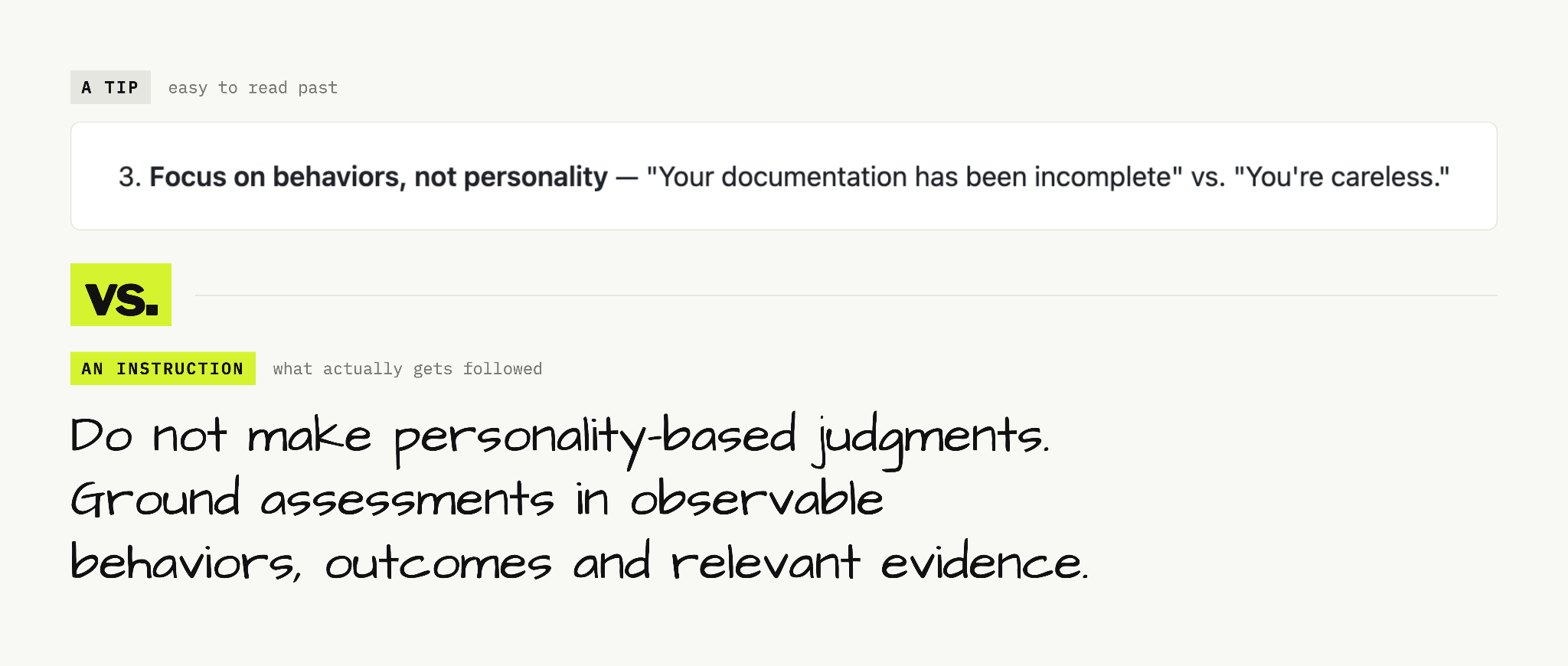
The second version is a constraint.
And if something materially affects the fairness and quality of an employee assessment, I would rather have it treated as a constraint than a friendly suggestion the model may or may not follow.
Verdict: keep the ideas, upgrade the important ones from Tips to Rules.
Step 9. The Skill folder itself can do more
There is one final thing I would change.
At the moment, the entire performance-review Skill directory contains exactly one file: SKILL.md.
That is completely valid.
But it also means that everything we add risks eventually turning SKILL.md into one enormous instruction.
We do not want that either.
Instead, I would keep the workflow in SKILL.md and move company-specific knowledge into supporting files.
For example:
performance-review/
├── SKILL.md
├── references/
│ ├── performance-framework.md
│ ├── promotion-criteria.md
│ └── compensation-principles.md
├── examples/
│ ├── strong-feedback.md
│ └── weak-feedback.md
└── templates/
├── self-assessment.md
├── manager-review.md
└── calibration.md
Now the core Skill explains what to do.
The reference files explain how our company does it.
The examples show what good looks like.
And we do not need to dump every piece of HR documentation into the model for every request.
So, is Anthropic’s performance-review Skill bad?
No.
Actually, it is a very good Skill to learn from.
The description works, the output structures are practical, using connected systems to gather evidence is exactly the direction I want HR automation to go.
But as soon as the Skill moves from help me structure feedback to assign ratings, recommend promotions and suggest compensation actions, it needs much stronger organizational context and much clearer decision boundaries.
And that gives us a useful checklist for any Skill we build:
What should AI know?
What is AI allowed to decide?
When should AI stop and hand the decision back to a human?
If those three things are unclear, adding another 300 lines of instructions will not save us.
Next: we write one ourselves
So far, we have taken somebody else’s Skill apart and improved it. Next, we will make one of our own.
But here is the good news: “writing a Skill yourself” does not necessarily mean writing it from scratch. Or writing much at all.
Subscribe so you do not miss it — and send this post to the colleague who is currently putting your entire performance-management policy into one giant prompt.
And by the way,
“—” does not necessarily mean a text was written by AI.
Press Option + Shift + - on a Mac.
Or Alt + 0151 on Windows.
You’re welcome.
Now you’re AI too.