


Every time I publish a post on Substack, there is a very tempting little button in the editor: Scan for AI text. It uses Pangram to estimate whether the text was written by a human or generated by AI.
Of course, I was intrigued, so I clicked it. Not every time, but often enough to know that Pangram is rather suspicious of me.
My posts regularly come back as more AI than human.
Which is funny, considering that this newsletter is, well, you know, about AI.
For example, here is the scan result for my post about Skills:
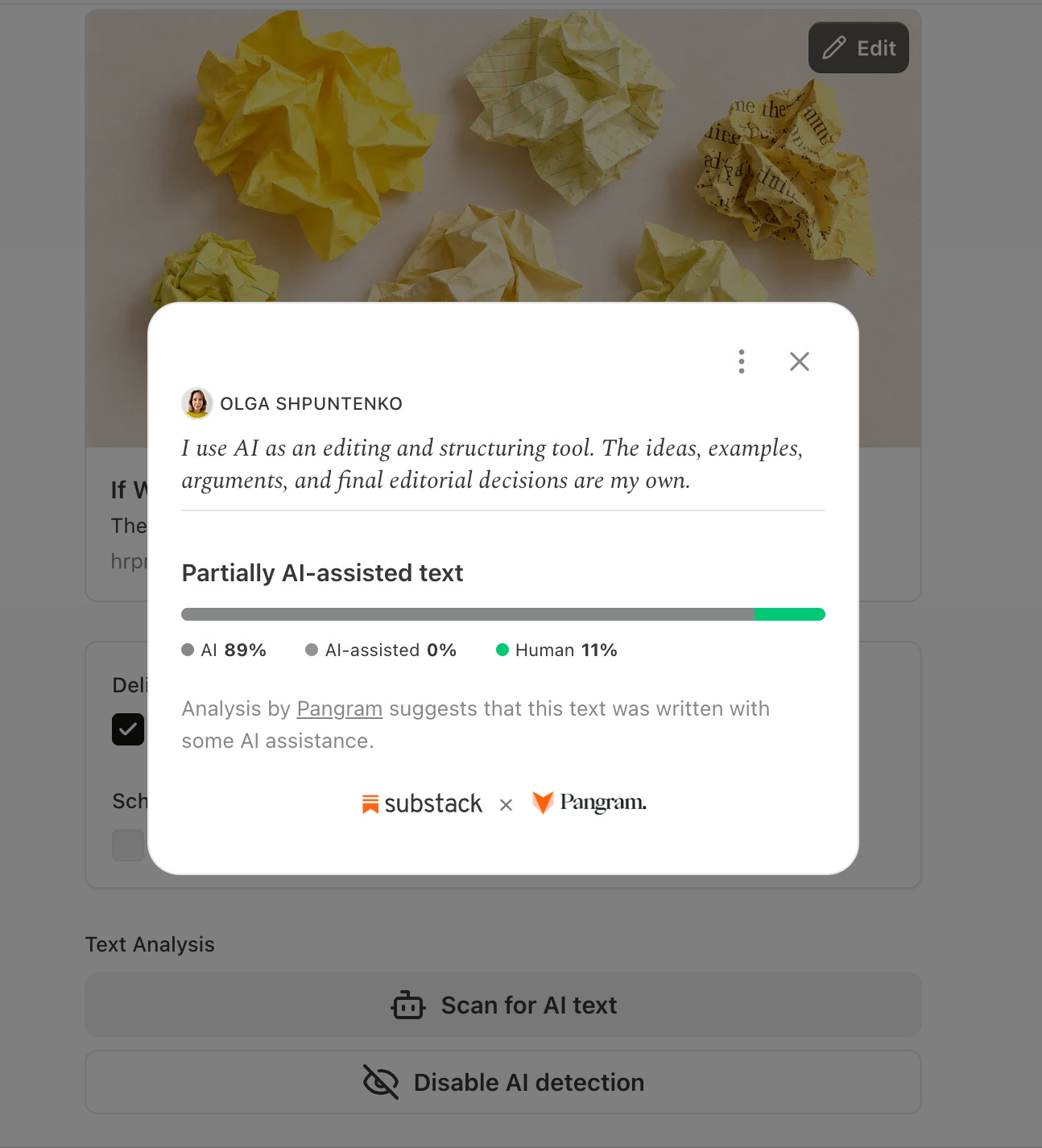
Let me tell you how it was actually written.
It starts in whatever language my brain picked that day
I use three languages in my daily life, so ideas tend to show up in whichever one my brain happens to be using at that moment. That is not always English.
Sometimes my notes are almost an article. Sometimes they are disconnected paragraphs, examples, screenshots, random observations, and something I typed angrily after seeing another “AI for HR” post on LinkedIn. But the thinking starts with me.
Then I bring all of that into LLM.
It already has context about this newsletter: who I write for, what we have discussed before, how technical I want to get, what I consider painfully generic, and what I absolutely do not want my writing to sound like.
It also knows how I write: my tone of voice, the kind of jokes I make, the phrases I tend to use, and all those small things that make a text sound like me.
Then I ask them to turn my material into an English draft. Not to translate it word for word. To make it sound like natural English.
That alone saves me an enormous amount of time.
And that’s when the editing really starts.
And editing AI is becoming a skill of its own
The first draft is almost never the post you eventually read: I cut paragraphs, move things around, put things back.
I ask LLM what exactly it meant by a sentence, and who it thought it was talking to, because I meant none of that.
When I get annoyed, I stop chatting and start sending screenshots with comments instead.
Ask for five alternatives and dislike all five.
Remove conclusions it invented because apparently every article needs to end with the future belongs to those who...
You know. Writing.
Except now there is another layer to it
We already have recognisable signs of AI writing. They’re so familiar by now that Wikipedia has an entire page devoted to them: generic significance, superficial analysis, certain sentence structures, the rule of three, suspiciously enthusiastic conclusions, excessive bolding and, yes, overuse of my favourite em dashes.
To be fair, Wikipedia itself is very clear that these are indicators, not proof that AI wrote something. And there are already services that specifically scan your writing for AI-sounding clichés and rhetorical patterns rather than trying to establish who actually wrote it.
So of course I notice those things too.
I remove them, I ask for another version, I rewrite them myself. And I resent this a little. The rule of three has been around for millennia, for God’s sake. Why am I suddenly supposed to feel guilty for using it?
I am absolutely certain that next month someone will launch a brand-new revolutionary service that can detect AI writing even more accurately. It will scan my post and solemnly announce that a soulless machine did the work for me.
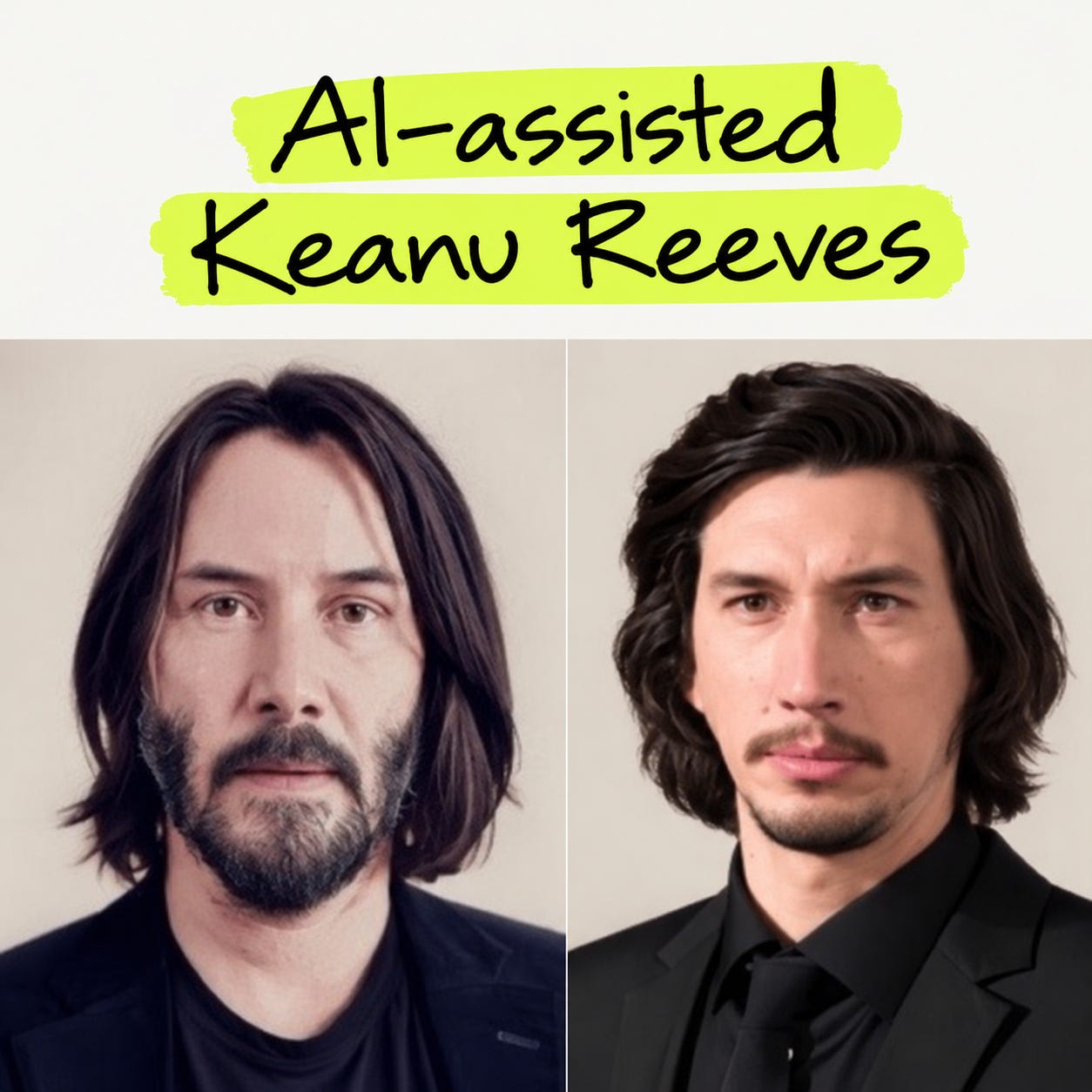
And that I (presumably) was too lazy to write it myself.
Wait.
Let’s talk about that.
Is “AI-assisted” a fact — or a diagnosis?
Because somewhere along the way, AI-assisted stopped being a description of how something was produced.
It started sounding like a judgement of the person who produced it.
Oh. You used AI.
Oh. You’re one of those.
Suppose I give an AI a dataset and ask it to produce a report.
Fine, AI-generated report. Guilty. Now what?
What exactly does that tell you about my work? Was I lazy? Or maybe I spent two days deciding what data mattered, cleaning it, giving the model the right business context, challenging its conclusions and eventually the AI helped us see something we had been missing:
our problem isn’t that hiring is too slow. Our problem is that we keep losing the people we have already hired. So instead of pouring another few million into recruitment, we shift the budget into retention.
Who just saved the company several million? Me or AI?
The model did part of the work. I did the work of deciding what work needed to be done.
Those are not mutually exclusive statements.
We need better questions
This distinction matters far beyond newsletters. Imagine two managers writing performance reviews:
one asks LLM to write feedback about an employee, barely reads the answer and submits it,
another has six months of notes, writes the key observations herself, uses AI to organise them, notices that one conclusion is poorly supported, goes back to the evidence, rewrites the draft and takes responsibility for every statement that reaches the employee.
Both used AI and produced AI-assisted text (shame on you!). Those processes are not equivalent.
So instead of obsessing over whether AI touched the work, I would rather ask:
What did the human contribute?
What decisions required human judgement?
Could the human explain and defend the result?
Who is accountable for the final decision?
Those questions tell me something about the quality of the work. “89% AI” does not.
Interestingly, regulation is starting to recognise the difference too
The EU AI Act does not simply say: AI touched this, therefore label it. That is a much more interesting distinction.
Not: Did AI generate words? But: Who ultimately owns the result?
For AI-generated or manipulated text published to inform the public on matters of public interest, Article 50 contains a disclosure obligation — but the obligation does not apply where the content has undergone human review or editorial control and a person or organisation holds editorial responsibility for it. The European Commission also explicitly says that a superficial grammar check is not enough: human review means substantive examination by someone with relevant judgement.
Which brings me back to this post.
So did AI write it?
Yes. Obviously.
ChatGPT helped me structure it. Claude Design makes illustration based on drafts. LLM cliché highlighter helps me make the text sound less AI-written. I have a dedicated SKILL.md with the fonts, colour codes and visual rules I want it to follow.
AI is all over this publication.
But I decide what I want to say, verify the things that need verifying, make the final editorial decision.
And if this post turns out to be nonsense, I am not going to blame ChatGPT.
So perhaps Pangram is right, this really is AI-assisted writing.
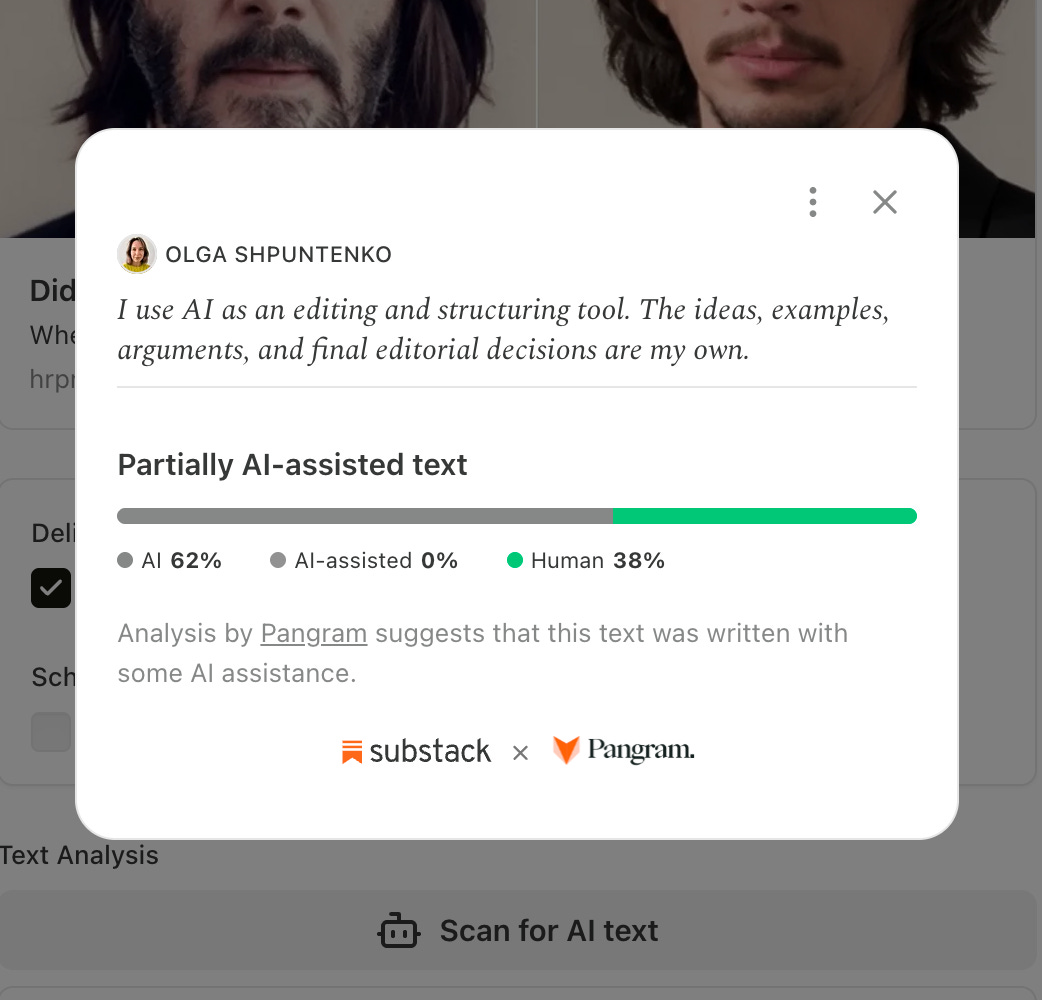
This is how Pangram evaluated this particular post, by the way
Stay tuned
We apparently still have a few things to figure out before the robots take over completely — starting with whether we should stop asking robots to tell us whether robots did our work.
And by the way,
“—” does not necessarily mean a text was written by AI.
Press Option + Shift + - on a Mac.
Or Alt + 0151 on Windows.
You’re welcome.
Now you’re AI too.