


“Rewrite this email.”
“Summarize these interview notes.”
“Turn this spreadsheet into five slides.”
“Make this policy sound friendlier.”
None of these is a bad use of AI. Sometimes you really do just need a better email.
But look at what happened before the model entered the picture. A human already decided what the problem was, what work should be done, and what the output should look like. AI gets the last executable piece.
We are giving increasingly capable systems surprisingly unambitious jobs.
The seed for this post came from Felix Rieseberg’s recent essay, How to be more ambitious: A tutorial for humans with models.
We have already learned to hand the monkey job to AI. The problem is that we often stop there.
We use it for faster emails, faster one-pagers, faster slides. Useful, yes. But still a very small job for the tool. So let’s look at what happens when we stop asking AI to do the next obvious task — and start asking it to help us achieve the result behind it.
Stop briefing the operation. Brief the result
This distinction matters because most AI prompts are still framed around the operation, not the result.
We ask for the document, the summary, the dashboard, the draft. But in most cases, none of those things is the real goal. They are just artifacts.
A Task is the action itself: summarize the survey, draft the policy, analyze the spreadsheet.
An Outcome is the change you actually want: understand why onboarding satisfaction dropped, decide whether a policy needs to change, identify where the hiring funnel is losing qualified candidates.
There’s an old Marketing 101 lesson: people don’t buy a hammer because they want a hammer. They buy it because they want a picture hanging on the wall.
That is the difference between asking AI to do a piece of work and asking it to help deliver a result.
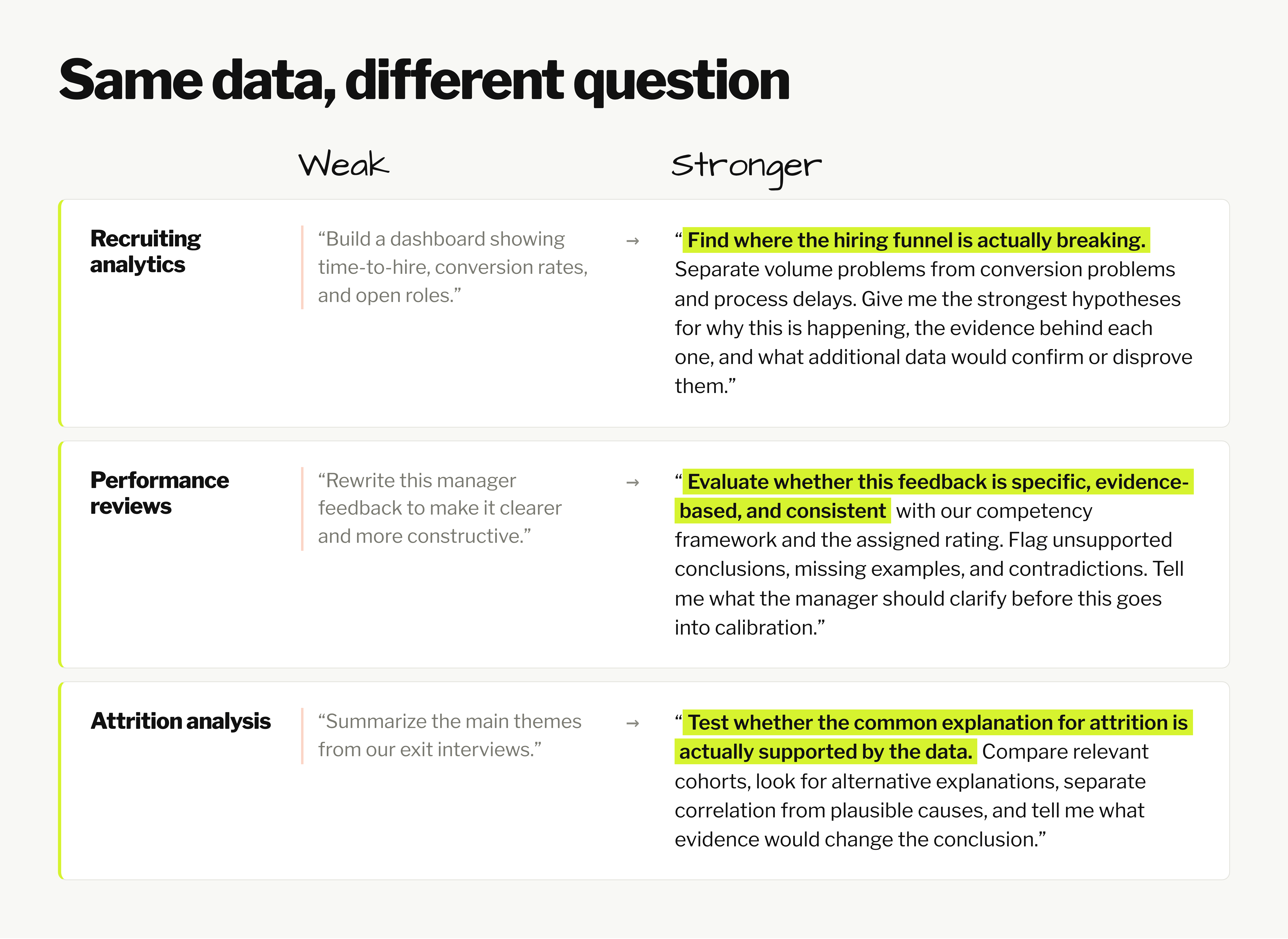
More ambitious does not always mean bigger
There is an obvious trap here: once people hear think bigger, they start designing a 14-agent workflow with six integrations for a problem that needed a better analysis.
The stronger prompt is not better because it is longer. It is better because it asks AI to do more of the thinking: test explanations, compare alternatives, identify missing evidence, and move closer to the actual decision.
Felix’s ideas of Depth and Range are useful here. Depth means doing the same job with more professional rigor. If the task is to analyze an employee survey, the ambitious move may not be build an engagement agent. It may be to look beyond the average score: compare relevant employee groups, check how results changed over time, separate recurring patterns from one-off comments, test alternative explanations, and identify what additional evidence you would need before recommending action.
Range means changing the lens, and analyze this like an HR expert is not enough. Ask how a competitor might interpret the same problem. How a product manager would frame it. What David Bowie might question about identity and reinvention.
The point is not to imitate a famous person’s tone. Borrow a different mental model and see whether it exposes something your usual professional lens misses.
Show me a perspective I would not have generated myself.
The point is to change the work being done.
Ambition has infrastructure requirements
A more ambitious prompt does not mean AI can magically do everything.
If you want AI to monitor your recruiting funnel, it needs recruiting data. If you want it to compare today with history, it needs that history. If you want it to take action, it may need integrations, API access, permissions, scheduled execution, or tools it can actually operate.
There is one more requirement people often miss: the model should not be the only judge of its own work.
Check your answer carefully is useful, but it is not independent validation. The same model can confidently approve the same mistake it confidently produced. Use an outside check when the result matters: tests, an independent calculation, a policy rule, or review by the accountable human expert.
AI can participate in quality control. It should not define the bar, produce the work, and certify that it passed.
Try this on one boring task
There is a method called the Five Whys: you keep asking “why?” until you get past the obvious explanation and closer to the real problem.
You can use the same logic to find the real goal behind an AI task.
Start with something you regularly ask AI to do:
Summarize our employee survey results.
Then ask:
Why do I need this summary?
Because I need to understand what employees are unhappy about.
Why do I need to understand that?
Because I need to know which problems require action.

I can hear this photo
Why does that matter?
Because we cannot fix everything, so I need to know what is most likely to improve the employee experience.
Now the task looks very different.
Instead of Summarize the survey you can ask:
Identify the two or three employee experience problems that deserve attention first. Show me what evidence supports each one, which employee groups are most affected, what alternative explanations are possible, and what additional data I should check before deciding what to do.
You do not need exactly five whys. Stop when the answer is no longer another deliverable — a report, a deck, a summary, an email — and starts describing the result you actually care about.
Then give that to AI.
Stay tuned and send this post to the colleague who has a frontier model open all day and mostly uses it to make emails sound friendlier.
And by the way,
“—” does not necessarily mean a text was written by AI.
Press Option + Shift + - on a Mac.
Or Alt + 0151 on Windows.
You’re welcome.
Now you’re AI too.