


A Project instruction usually starts innocently: a few rules about the company, your role, maybe a reminder not to invent facts or write every employee announcement like a LinkedIn thought-leadership post.
Perfectly reasonable.
Then you add a checklist for promotion cases, instructions for manager communications, emails, scorecards, and that very specific rule about never using the phrase fast-paced environment because we have suffered enough.
Before long, your Project instructions have won HR bullshit bingo.
And every time you ask Claude or ChatGPT to “quickly” rewrite a two-line Slack message, all of that comes along for the ride.
This is where Skill.md become useful.
Projects and Skills solve different problems
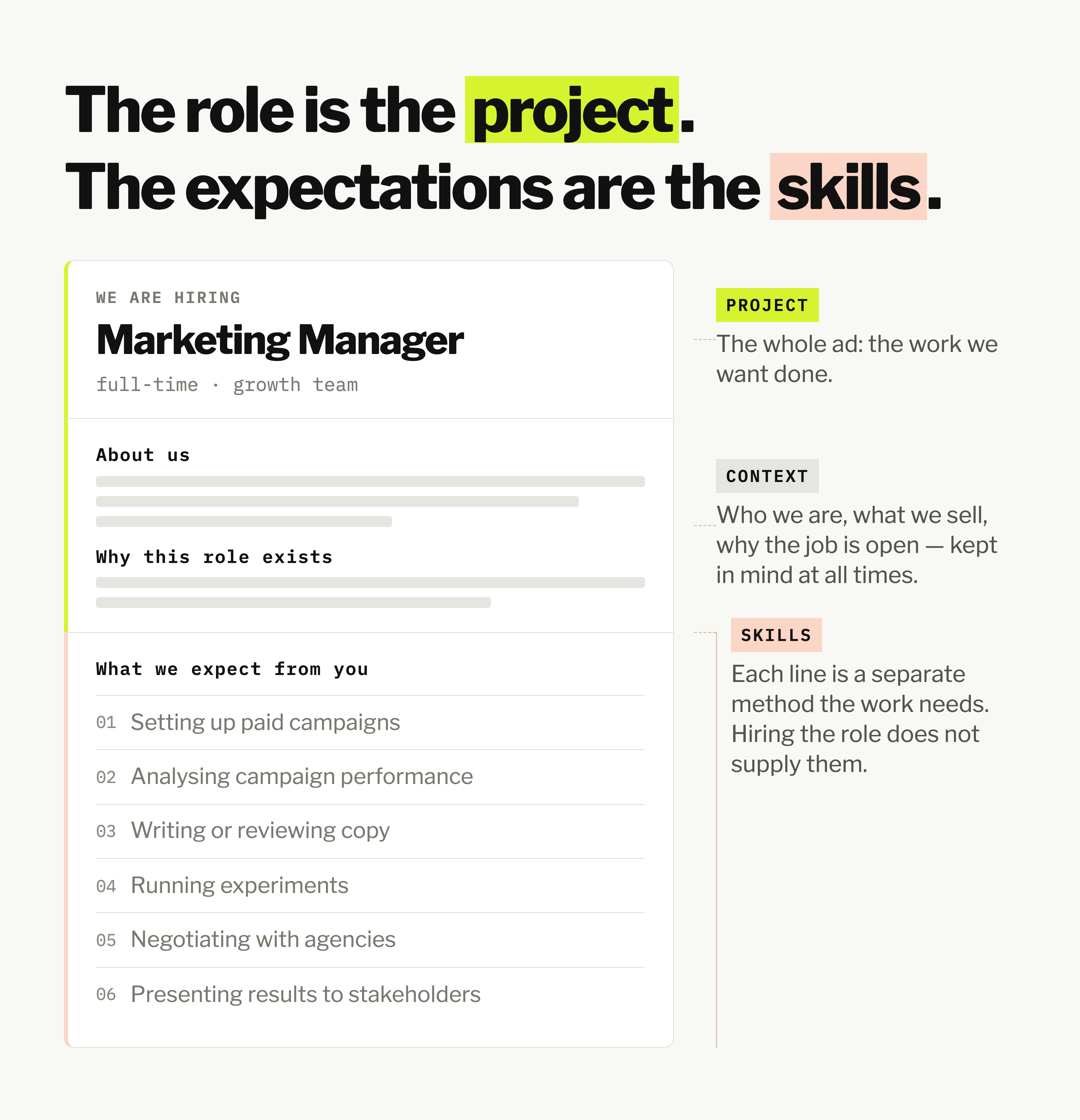
If I create a Project for my company, there are things I probably do want Claude to know all the time, rules that should apply regardless of the task: how our organisation is structured, which terminology we use, whether we write in British or American English, perhaps the relevant company policies, frameworks and other reference material.
That is persistent context.
But imagine that inside the same Project I also have detailed instructions for writing job descriptions, editing performance feedback, and drafting employee communications.
They all involve writing. They may all belong to HR, but “HR” is not a workflow.
Writing a job description, feedback, or invitation to all-hands require different context and different ways of working.
We have spent decades explaining to managers that HR is not one giant miscellaneous function. It would be unfortunate to build our AI workflows as if it were.
Think in layers, not in one enormous prompt
Suppose I have a Project for Acme Corp. The Project might tell:
You are supporting the People team at Acme Corp, a 600-person B2B software company operating across Europe and the US.
It might also contain the company’s: level structure, leadership principles, communication style, relevant policies, rules such as “do not infer employee facts that were not provided.”
Good. Now I ask:
Rewrite this performance feedback. The manager says the employee “needs to be more strategic.”
At that point, I need much more than company context.
I may want a specific method.
Identify the expected behaviour at this employee’s level.
Separate observed behaviour from interpretation.
Identify vague or personality-based statements.
Check whether there is enough evidence.
Rewrite the feedback around behaviour, context and impact.
That is not something Claude (or ChatGPT, or Copilot, whatever) needs for every task at Acme Corp. It is a performance-feedback Skill.
Tomorrow I may ask it to create a job description or an employee announcement — it will still be about Acme Corp, but there will be other skills in other contexts.
Why not just put everything in the Project?
You can.
In exactly the same way you can keep every HR template your company has ever produced in one folder called HR FINAL. It will work for a while. The problem appears as the setup grows.
Your Project instructions become longer. Rules for unrelated tasks start living next to each other. And Claude receives context that may have absolutely nothing to do with the current job.
If I am drafting a benefits announcement, I do not need detailed instructions on interview calibration. If I am reviewing a candidate scorecard, I do not need the six-step process for writing a performance improvement message.
More context is not automatically better context. Sometimes it is just more context. I went into this in more detail in How to Cure AI Amnesia at Work.
There is another advantage: workflows travel
Imagine you develop an excellent process for improving performance feedback. That method is not unique to Acme Corp.
The competency model might change from company to company. The rating scale might change. The words Senior and Lead may mean completely different things because of course they do.
But the method for interrogating weak performance feedback can remain largely the same. That is exactly the kind of thing worth separating into a Skill.
The company-specific context stays with the Project, but the reusable professional method travels with you.
For HR, this distinction is particularly useful because so much of our work has exactly this shape:
stable organisational context + repeatable professional procedure.
So what should stay in the Project?
The Project provides the environment. The Skills provide specialised ways of working inside it.
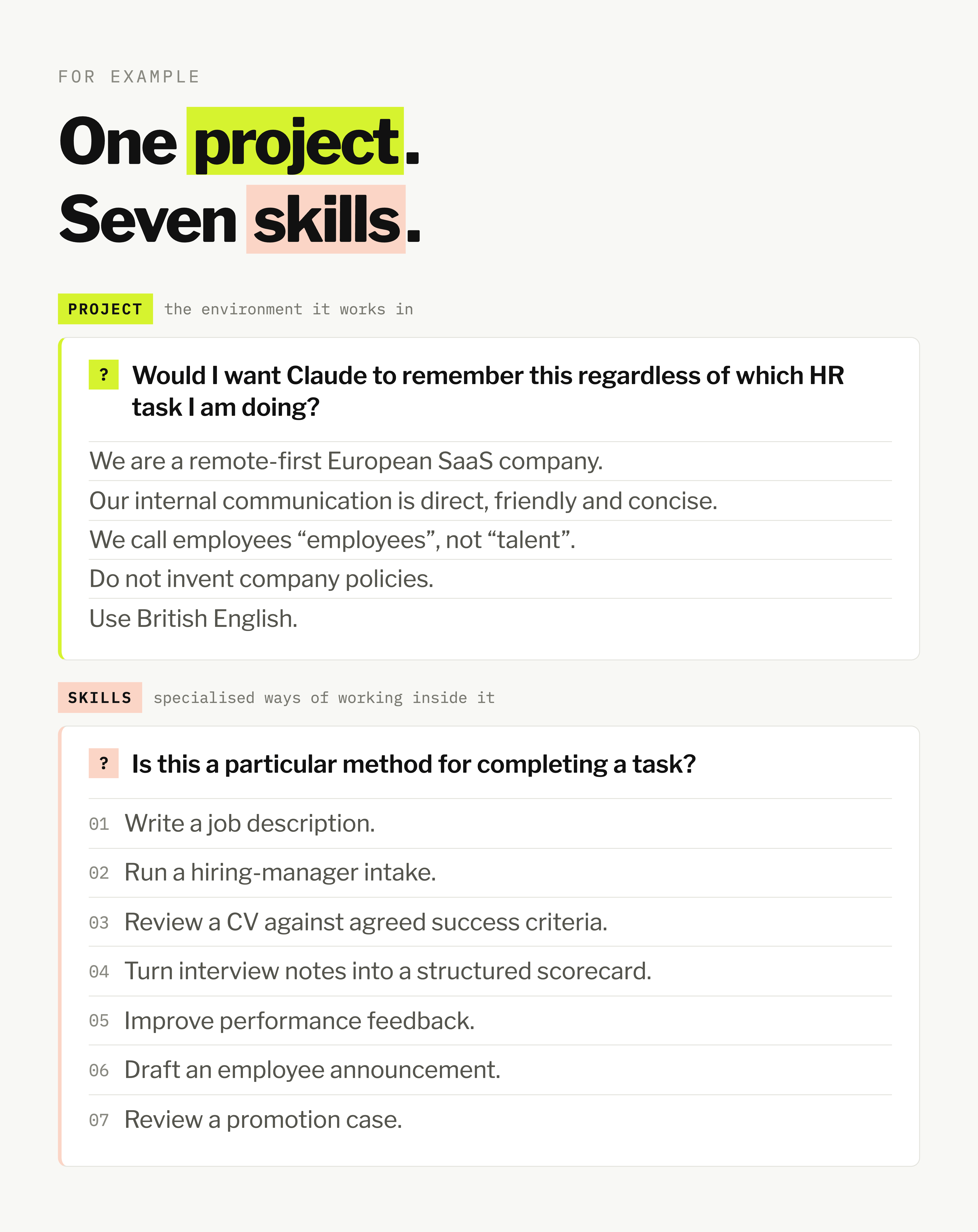
And no, you do not have to choose one. Projects and Skills are not competing approaches, they are great working together.
In the next post, we’ll take a Skill apart and look at what belongs inside it — and, just as importantly, what doesn’t.
Send this to a friend whose Project instructions currently contain the company handbook, the recruitment process, the performance review methodology and one strangely specific rule nobody remembers adding.
And by the way,
“—” does not necessarily mean a text was written by AI.
Press Option + Shift + - on a Mac.
Or Alt + 0151 on Windows.
You’re welcome.
Now you’re AI too.