


In the previous post, we ran into the next problem: How big should a Skill actually be?
There is a popular answer — one Skill, one purpose.
Correct. Also not terribly helpful.
Because what exactly counts as one purpose? Is recruitment one purpose? Is checking whether those companies actually employ enough relevant engineers another one?
So before we start cutting Skills into pieces, let’s define two terms.

First: what does granularity mean?
Some time ago, I joined the army of specialty coffee people, so let’s use something close to my heart.
Coffee can be ground coarse or fine. A coarse grind gives you fairly large particles. An espresso grind is much finer. That precision is useful — but it also works in a much narrower setup. Put espresso-fine coffee into the wrong brewer and you may get a very unpleasant lesson in extraction.
Skills have roughly the same problem.
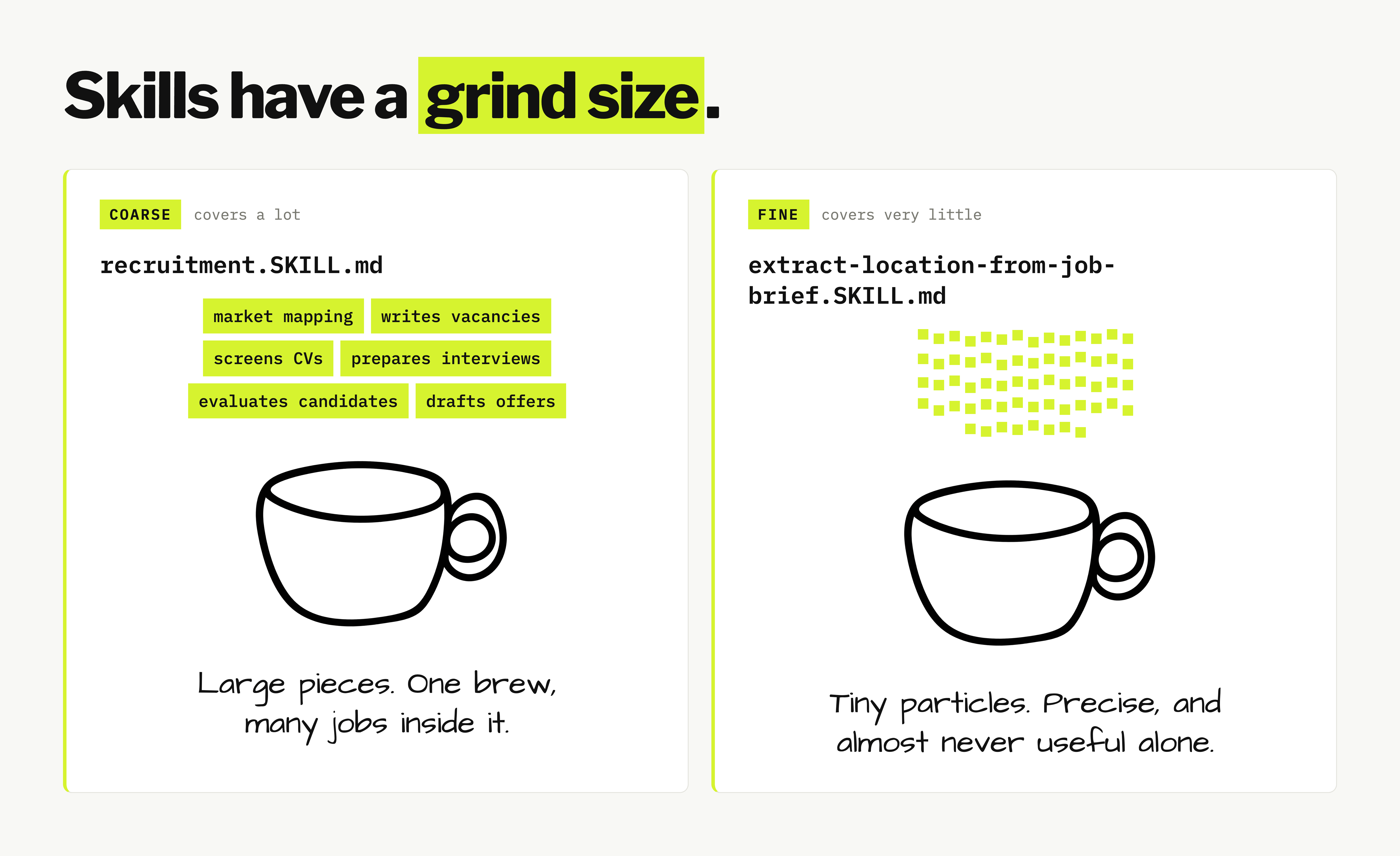
Granularity is simply how much responsibility you pack into one Skill.
Neither extreme is automatically good. Too broad, and your Skill starts mixing unrelated instructions, inputs, outputs and quality criteria. Too narrow, and you create a pile of tiny components that are annoying to maintain and almost never useful on their own.
My preferred version of “one Skill, one purpose” is:
One Skill should own one recognisable job with one clear definition of success.
That is much easier to work with.
Stop counting lines
You can find fairly specific recommendations online: three to five responsibilities, two to five workflow phases, a few hundred lines, and so on.
I would treat those as warning signs, not laws of physics. A 150-line Skill can still contain three unrelated jobs at the same time as a 600-line Skill can describe one complicated job extremely well.
And there is another important reason not to obsess over file length.
The goal is not to make your Skills small. The goal is to make them coherent.
Agent Skills use progressive disclosure: the agent first sees only enough data to understand what a Skill does. It loads the full SKILL.md when the Skill becomes relevant, and can then load additional reference files only when needed.
So these are actually two different questions:
Does this need to become several Skills?
Is this still one Skill, but with too much information in one file?
Those problems need different solutions.
Example: market mapping
Let’s say Talent Acquisition needs to answer where should we search for senior payment engineers in Europe. A useful talent-market-mapping Skill might:
clarify the target profile;
translate the hiring brief into search criteria;
identify relevant industries and companies;
group companies by geography or business model;
estimate where relevant talent is likely to cluster;
return a structured market map.
That is several steps, but they all serve one recognisable outcome: Give me a defensible map of the talent market for this role. So I would not create: identify-target-industries, find-companies, classify-companies, analyse-geographies, write-market-map just because the workflow has five stages. The stages belong together.
Now imagine someone adds:
Write personalised LinkedIn messages to the candidates we find.
That is excactly where I would split. Candidate outreach has a different trigger, different inputs, different writing rules and a completely different definition of good output.
The fact that both activities happen inside recruitment does not make them one capability.
The five-question granularity test
When I am unsure whether something should be one Skill or several, I use this:
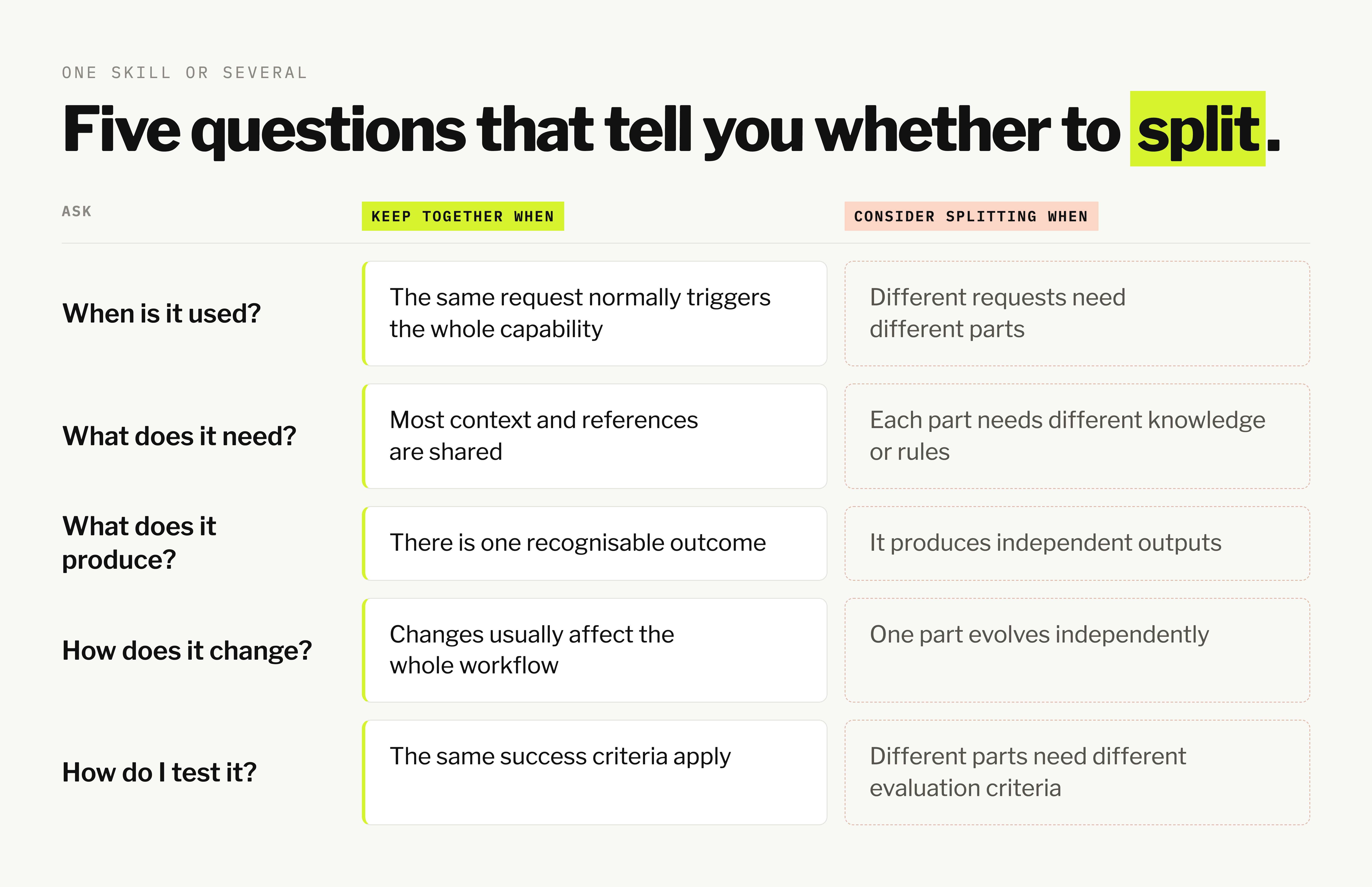
You do not need five perfect matches.
But if you keep landing in the right-hand column, there is probably more than one Skill hiding in your file.
What if the Skill is coherent, but huge?
Do not automatically split it.
Imagine your market-mapping Skill needs:
the core workflow;
your internal definition of seniority;
approved role families;
geographical classifications;
industry taxonomy;
examples of previous market maps;
instructions for interpreting incomplete LinkedIn data.
That is a lot of material. But it may still be one capability.
That is exactly what progressive disclosure is for. Anthropic explicitly recommends linked files when a Skill grows in complexity or contains information relevant only in particular scenarios.
Instead of creating six Skills, you can structure one Skill properly:
talent-market-mapping/
├── SKILL.md
├── references/
│ ├── seniority-framework.md
│ ├── role-taxonomy.md
│ └── geography-rules.md
└── examples/
├── engineering-market-map.md
└── commercial-market-map.md
The core instructions stay in SKILL.md. Detailed material sits in reference files and is loaded when needed.
And then there is Skill stacking
Now we need one more term.
You may have come across the term skill stacking in Forbes or LinkedIn. The term has become especially common alongside conversations about skills-based organizations and moving beyond traditional job descriptions. There, it usually means combining human capabilities — for example, domain expertise + data analysis + communication.
In the Agent Skills world, the idea is slightly different. The closely related technical concept is usually called composability. Anthropic describes Skills as composable: Claude can identify several relevant Skills, load them together, and coordinate their use. A Skill should be able to work alongside other Skills rather than assume it is the only capability available.
In other words, one complicated task does not require one gigantic Skill. It may require several useful Skills working together.
Example: the Executive Board wants a People Analytics dashboard
Imagine this request:
Prepare the monthly People dashboard for the Executive Board. Highlight meaningful changes, explain what may be driving them, and prepare the management commentary.
There are several capabilities hidden inside that task.
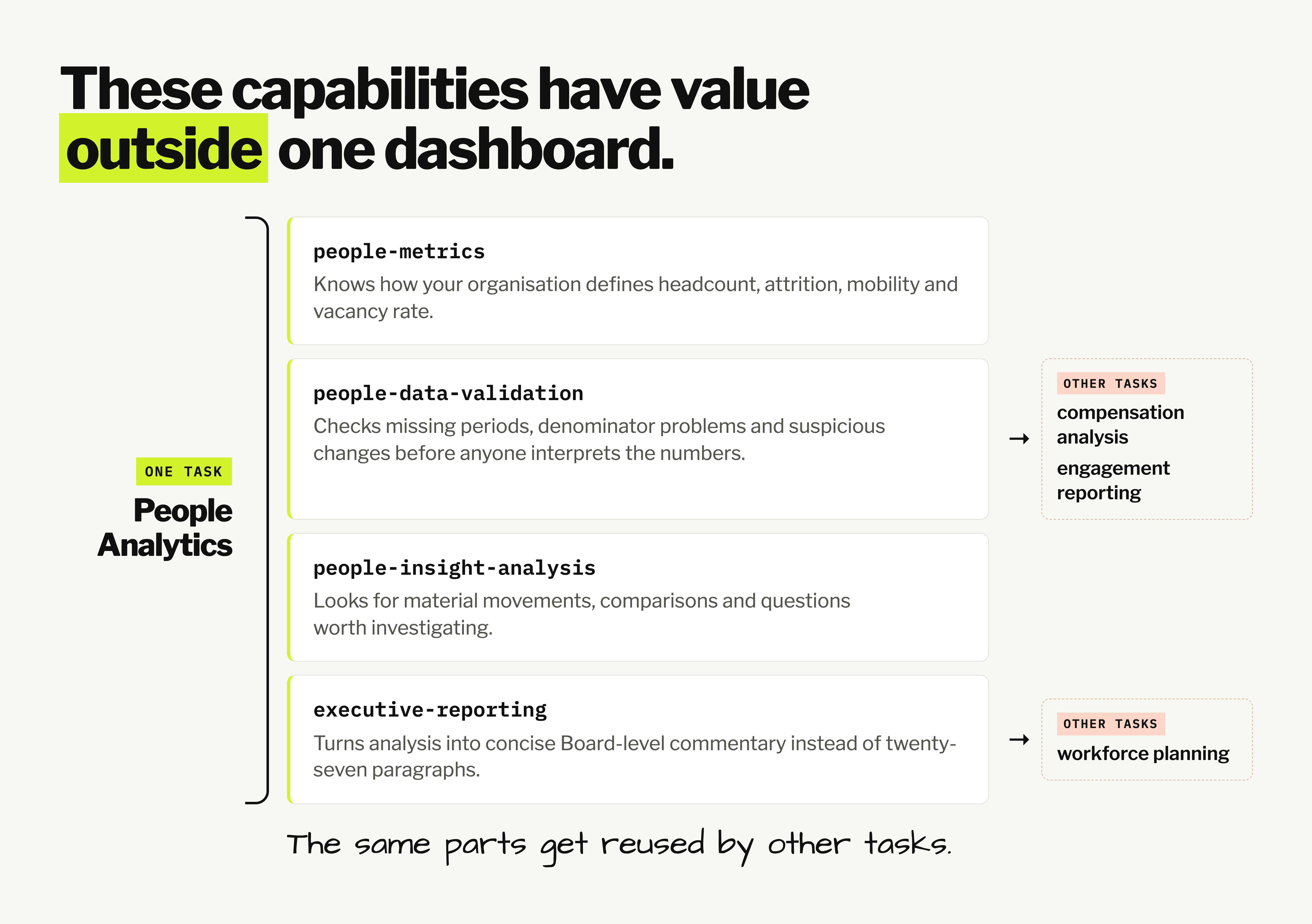
The point is not that this exact architecture is correct for every company. The point is that these capabilities can have value outside this one monthly dashboard.
Now we have actual modularity. The capabilities can be composed instead of being rebuilt inside one monolithic agent.
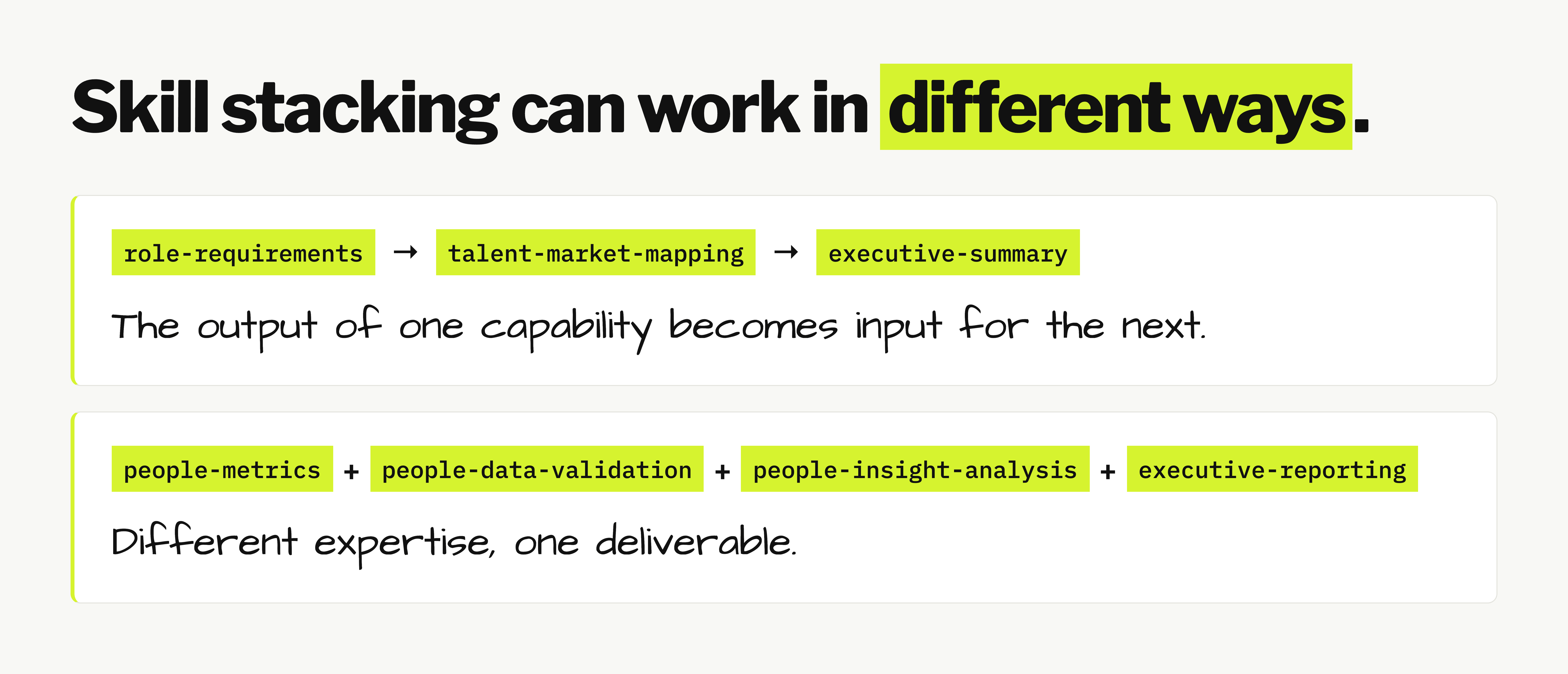
And the stack can change depending on the request.
Imagine if the HR Director asks:
Check whether our attrition calculation is correct.
you may only need the metrics and validation capabilities.
If the CEO asks:
Turn this analysis into three slides for tomorrow.
you may need analysis + executive reporting + presentation creation.
That flexibility is the point.
When should you merge Skills again?
The other failure mode is Skill confetti.
Ask yourself:
Would I realistically use this Skill without the others?
If the answer is almost never, you may have one workflow that you chopped into five files. You probably already know what to do.
Another signal is duplicated instructions. If five Skills all repeat:
Use the approved role architecture.
Do not invent missing information.
Distinguish evidence from assumptions.
Apply the same geography rules.
your supposedly modular architecture may actually be creating more maintenance work.
So how big should a Skill be?
Split it when:
it performs more than one recognisable job;
different parts require substantially different context;
outputs can be useful independently;
one part could realistically be reused in other workflows.
Keep it together when:
they lead to one meaningful outcome;
they rely on mostly the same rules and context;
splitting would create dependencies rather than reuse.
Still unsure?
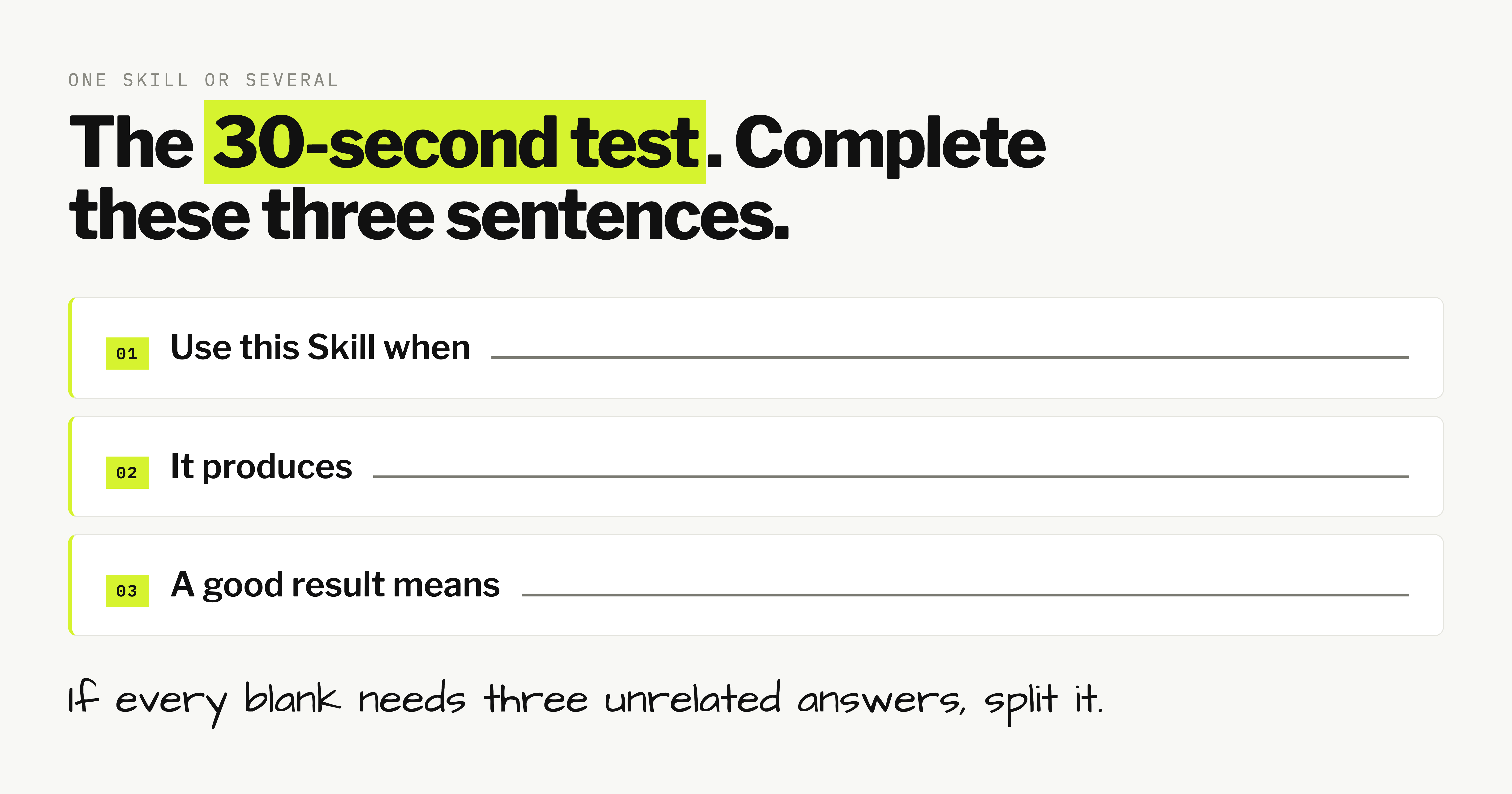
Sometimes Skills break because one tiny change can affect the whole system. Better to find that out before the Skill is doing real work.
Send this post to the colleague downloading chro.md or hrbp.md and hoping one Skill will somehow do the whole job for them.
In the next post, we’ll look at how to test for exactly that — including the weird cases you did not think of when you built it. Subscribe so you don’t miss it.
And by the way,
“—” does not necessarily mean a text was written by AI.
Press Option + Shift + - on a Mac.
Or Alt + 0151 on Windows.
You’re welcome.
Now you’re AI too.