


Any HR business process is designed to make life easier for everyone involved. At least, that is the plan.
And then real life arrives.
“This is a special case”.
“We need to solve this one quickly”.
“We did not think anyone would do that”.
None of this necessarily means the process was badly designed.
A process can work perfectly well for 95% of cases and still leave you staring at the remaining 5%, wondering why nobody warned you that apparently this situation was possible.
You cannot predict every exception. But you can test what happens when the process stops getting the nice, clean inputs you designed it for.

A well-written Skill can still fail
By now, we have done quite a lot of work on our skill.md.
We designed the architecture, gave it structure, separated instructions from examples. We decided how big it should be, added rules and constraints instead of throwing everything into one heroic wall of text.
And then you use it on a real task and discover that it does something completely unexpected. Or worse: it works beautifully on the example you had in mind when you built it — and falls apart as soon as the task looks slightly different.
But it’s just a text file, what is there to break?
Quite a lot, actually.
A Skill can follow the right rule in one case and ignore it in another. Two perfectly reasonable instructions can start competing with each other. A new constraint can fix one problem and quietly create another. And an example that was meant to clarify the logic can end up steering the model more strongly than the rule itself.
So when we say a Skill “breaks”, we usually do not mean that it stops working completely.
We mean that its behaviour stops matching what we designed it to do.
And that is much harder to notice than an error message.
First, define what “good” means
Before testing anything, you need to know what you are testing for.
Otherwise, evaluation becomes Looks fine to me — which is approximately as useful as giving feedback after an interview like: I just didn’t feel the chemistry.
Very actionable.
Imagine we built a Skill that reviews job descriptions before publication. What would make its output good? Maybe it should:
identify requirements that are unclear or contradictory;
flag language that unnecessarily narrows the candidate pool;
distinguish legal requirements from hiring-manager preferences;
follow our company’s job-description structure;
never invent missing information;
ask for clarification when something important is missing.
Some of those criteria come from what the Skill is supposed to do. Others come from how your company wants that work to be done. The important part is that you decide what success looks like before you start deciding whether the output is successful.
Start with the boring cases
Your first tests should be painfully normal. Give the Skill exactly the kind of task it was built for.
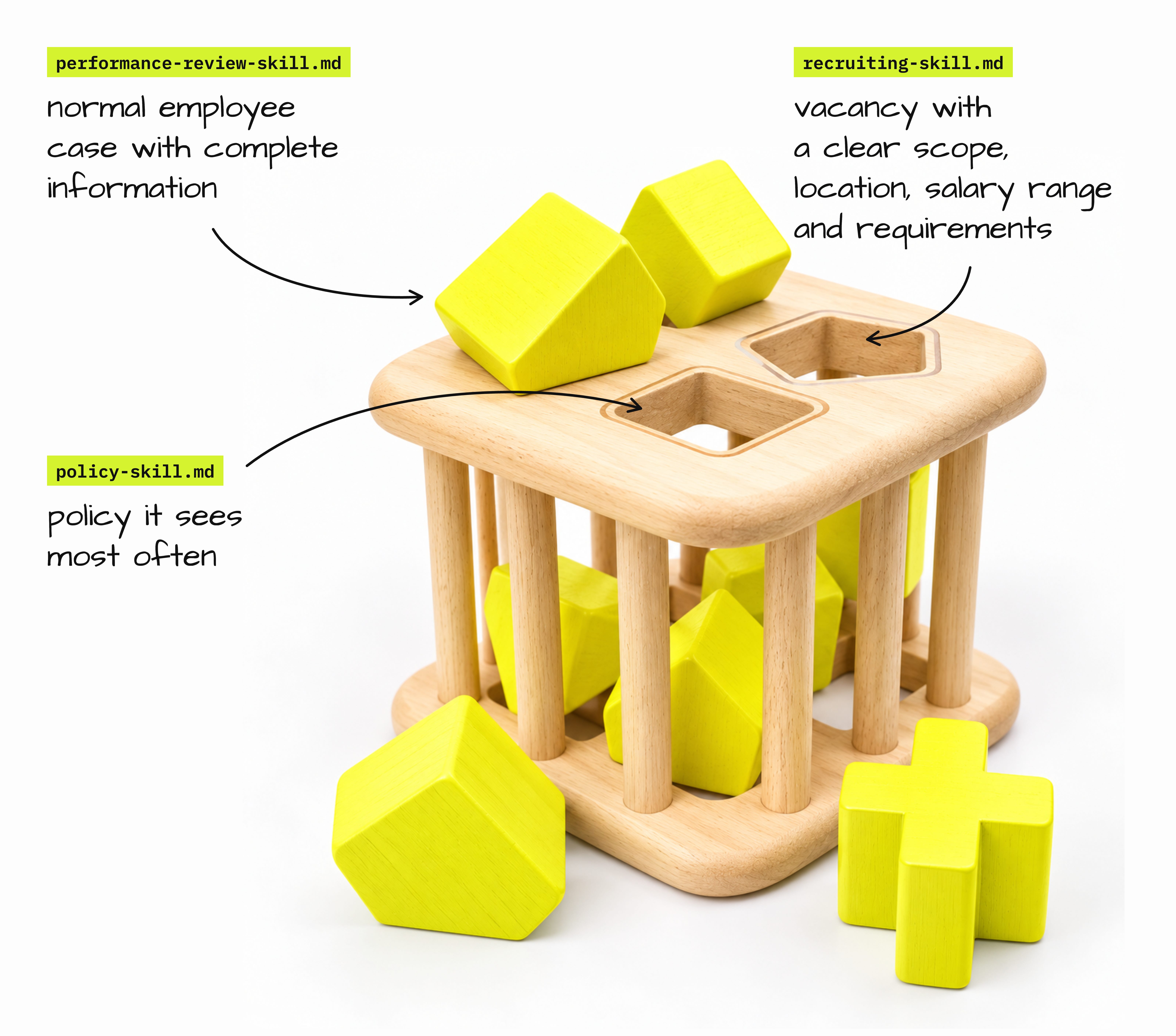
Before trying to break the thing, make sure it can actually do its basic job consistently.
And yes, these tests are boring. That is the point.
But! One successful output is not enough either — try a few variations of the same normal scenario (different wording, departments, or slightly different levels of detail). You are looking for something very simple: Does the Skill keep behaving like the same Skill?
Then stop being nice to it
This is where real games begin.
Real users do not deliver perfectly structured input: they send you only the signed page without the rest of the agreement. They ask for something that is almost, but not quite, what the Skill was designed to do.
So give your Skill those cases deliberately. For example:
The salary range is missing.
The manager asks for something prohibited by your own constraints.
Half the required information is absent.
The input includes irrelevant information.
Two instructions inside the request pull in opposite directions.
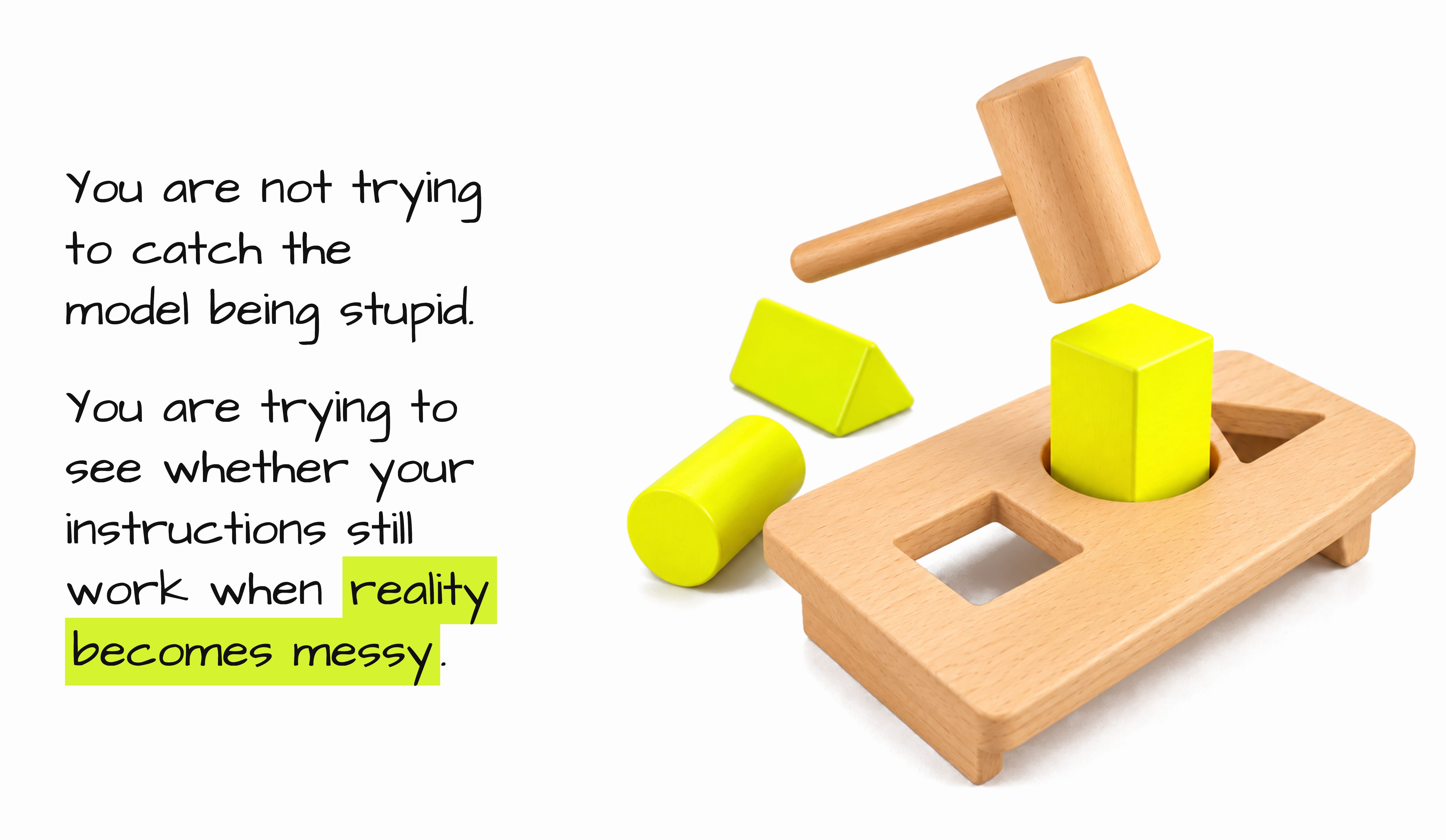
A good Skill does not necessarily have to solve every weird case.
Sometimes the correct behaviour is “I don’t have enough information to do this” or simply asking the right question before continuing. That is still a pass.
Keep the weird cases
This is the part people often skip: you find an edge case, fix the Skill, see that it works now — and move on.
Don’t.
Save the case. Every strange failure you discover in real life is a ready-made test for the next version of your Skill.
Over time, you will build a small test set without inventing dozens of artificial scenarios upfront.
And that matters for one reason — regression testing.
You fixed one thing. What did you break?
Let’s say one of your tests fails: the Skill keeps inventing a salary range when none was provided.
Easy — you promptly add a rule:
Never infer or invent compensation data. If compensation information is missing, ask the user for it.
Run the test again — perfect. Problem solved — maybe.
Because that tiny change now lives inside a system of other instructions, and LLM behaviour is not a collection of isolated switches. You changed one thing. That change can affect another part of the output.
Perhaps now the Skill:
asks unnecessary clarification questions even when the salary is irrelevant;
or it stops completing tasks it could safely complete with partial information;
or your new rule conflicts with an example elsewhere in the Skill.
This is why, after changing the Skill, you do not rerun the failed test. You rerun the tests. Plural. That is regression testing.
The term comes from software development, but the idea is wonderfully simple: When you fix something, check that the things that already worked still work.
For Skills, you do not need sophisticated infrastructure to start doing this. You need a repeatable set of cases and the discipline not to test only the thing you just changed.
How many tests do you actually need?
Your test set should grow because reality taught you something — not because someone told you that every Skill needs exactly 27 test cases. There is no standard for the “right” or exhaustive number of tests.
That is both good news and bad news.
The good news: you can start small. A few normal cases, a few bad-input cases, a few edge cases.
And now the bad news: you will never test everything. Your test set does not have to be complete before the Skill is useful. It should grow with the Skill — every time reality teaches you something new, you get another case worth keeping.
Fortunately, your colleagues will eventually help you. Trust them (or trust me: I’m sure they will always find a scenario you did not think of).
In the next post, we’ll talking about versioning and maintenance — how do you update Skill without losing track of what changed.
Subscribe so you don’t miss it.
And send this post to the colleague who wants to avoid something like: skill_final_v2_really-final_USE-THIS-ONE.md.
And by the way,
“—” does not necessarily mean a text was written by AI.
Press Option + Shift + - on a Mac.
Or Alt + 0151 on Windows.
You’re welcome.
Now you’re AI too.
So true. You can build a process or a prompt that looks bulletproof on paper, but the moment real human behavior or messy inputs hit it, the edges start fraying.
If you do not stress test your systems with the weird 5 percent edge cases before relying on them, real life will gladly do it for you.